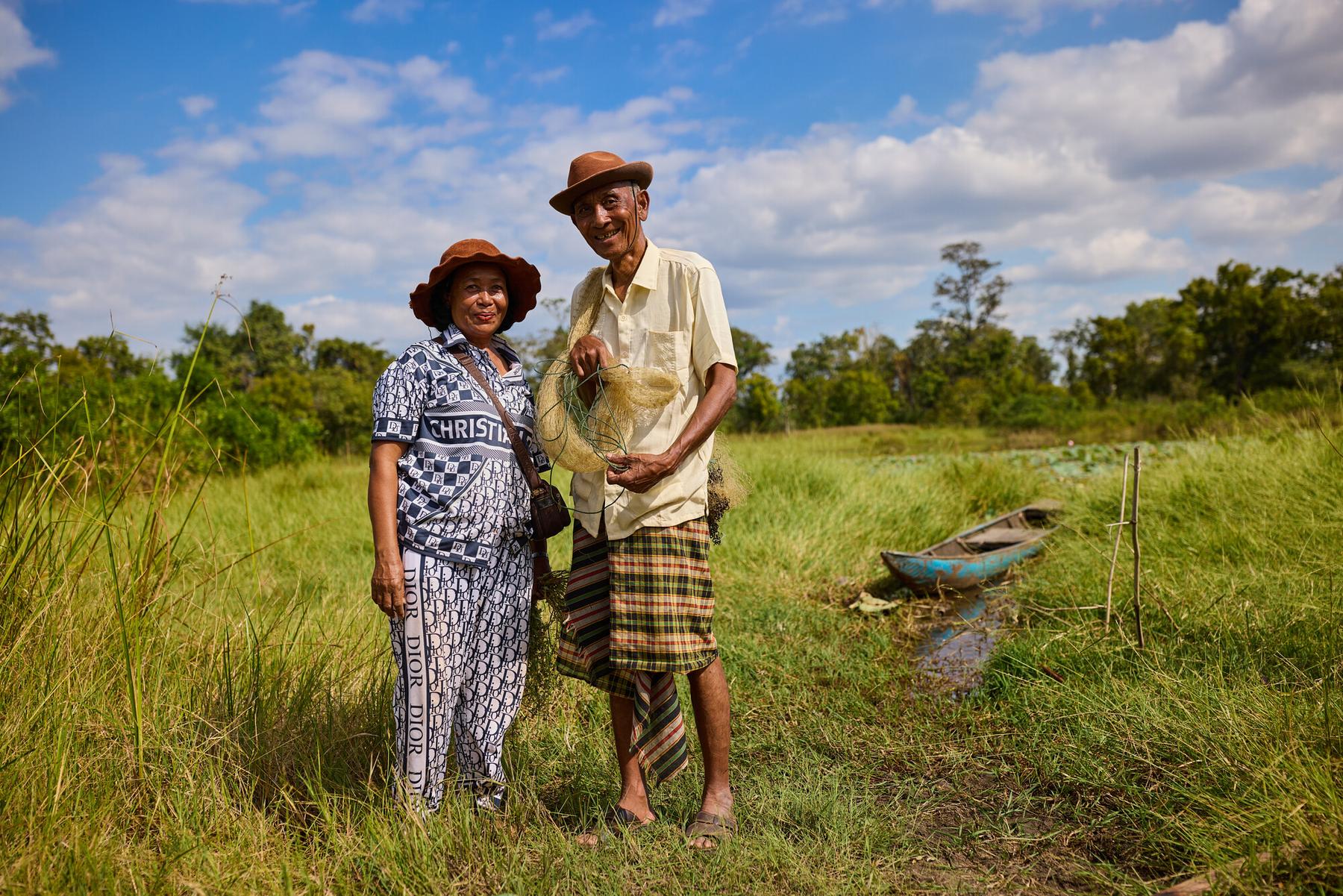
Cambodia: Chantheurn and her husband Savorn, a fisherman, show around the local lake that they have successfully protected from illegal activities such as overfishing and pumping. Photo: Patrick Moran/Oxfam. Oxfam acknowledges the support of the Australian Government through the Department of Foreign Affairs and Trade (DFAT).
Frequently asked questions
General
We spend at least 90% of funds raised from emergency appeals on our emergency response programs. The remaining 10% covers costs associated with advertising and promoting our appeals, operating our toll-free phone room, processing and receipting donations and audit and financial accountability.
For all other combined income, over the past three years, an average of about 67 cents in every dollar has helped to fund our development programs around the world. The remainder is spent on administration and fundraising costs or reserved for future program work.
Read more about where the money goes.
Oxfam Australia is a member of Oxfam International, an international confederation of 22 organisations (and two observer members). Together, we tackle inequality to create a world without poverty. We work alongside with local partners and communities in 76 countries. We are a Public Benevolent Institution (ABN 18 055 208 636).
We believe in the full and equal rights of all human beings and seek to help people whose rights are denied for reasons of poverty, discrimination or injustice.
Many of the reasons poverty and injustice exist are linked to the unfair policies and practices of governments, global organisations or businesses.
By engaging with governments and corporations through discussions, campaigns and advocacy, and by working with local communities, we seek a world where everyone is equal and no-one lives in poverty.
We are an independent development organisation and carry out our work free from party-political or religious agendas. We have no membership or affiliation to any political party or religion.
Oxfam Australia works in a number of countries around the world. More detail on our work in particular countries can be found in the countries where we work section of the site.
At Oxfam Australia, we believe all lives are equal and no-one should live in poverty. That's why we strive to deliver life-saving humanitarian relief, run long-term, anti-poverty projects and create campaigns for meaningful societal change. We work alongside local partner organisations, with communities and supporters, to create a world where everyone is equal and no-one lives in poverty.
We support people’s right to live in a fair, just world where they can exercise their basic rights:
- the right to live and security
- the right to a sustainable livelihood
- the right to be heard
- the right to have an identity
- the right to have access to essential services.
We work to achieve these rights for everyone. Specifically, we strive to:
- save lives before, during, and after humanitarian crises
- work alongside local partners and communities to support their fight against inequality and poverty
- influence governments, institutions and businesses to develop and implement laws, policies and practices that help people rise out of poverty.
No. Our projects focus on communities rather than individuals. We consider this a more effective and efficient approach for long-term developmental outcomes.
If you'd like to make challenge the inequality that keeps people in poverty, please consider making a regular gift to support our work.
Our strategic plan contains six goals to change the world: The right to be heard; Gender justice, Saving lives, now and in the future; Sustainable food; Fair sharing of natural resources; and Finance for development.
Our operational plans are based on these goals, and we undertake regional and country level planning to determine projects that will help us to achieve these goals. We take into account issues such as the environment, women, culture, community power structures, the local economy, existing resources and relationships that affect poverty and inequality, and we identify underlying vulnerability as well as potential risks.
We work with local partner organisations and communities as well as key staff within the organisation to identify the best way of delivering each project so that we achieve the maximum impact.
You can support a specific project or several development projects by making a regular donation.
We work with community members and project partners on project design and management. Our local partners understand what they need best, so communities are consulted to ensure their needs and priorities form the core of the project and are engaged as fully as possible in the project design process.
This process involves identifying stakeholders and their interests; analysing the causes of poverty and injustice; identifying the positive changes communities would like to achieve; assessing capacity to undertake the project; and developing a detailed project plan.
We continually monitor and evaluate each project to determine its impact and effectiveness. This involves reporting on a financial and project basis, regularly visiting sites, annually conducting field office and partner audits, and conducting formal evaluations of the project.
We ensure that we always collect and analyse feedback from community members so we genuinely understand how the project has helped to improve people’s lives and what we could have done better.
To learn more, explore our project evaluations on the Resource Hub.
Our programs are designed to enable people to empower themselves and lift themselves out of poverty.
We make sure the needs, preferences and beliefs of community members are central to the project design and planned outcomes.
Community members are trained in key skills and often provide labour and materials, giving them ownership of the project. In this way we work to make projects sustainable, although unforeseen events such as political instability can sometimes undermine our work.
During a program, communities improve the capacity to meet their own needs — so the benefits of the projects continue long after we leave.
Before we begin a project, campaign or emergency response, we consider what other international aid agencies are doing so that our work will complement existing efforts. We work together when a collaborative approach will increase our effectiveness, such as the study we have conducted with World Vision Australia and the Australian Red Cross into combined logistics operations for emergencies. We also collaborate with organisations on campaign initiatives.
Our campaigns in Australia are funded by non-tax-deductable income received from supporters and organisations who wish to support our campaigning for change.
Operating at all levels — from individual households to global forums — Oxfam Australia strives to:
- save lives before, during, and after humanitarian crises
- work locally with people and communities to support their development and influence policies and practices that will reduce poverty
- influence governments, institutions and businesses to develop and implement laws, policies and practices that help people rise out of poverty.
We also run humanitarian appeals — to which the Australian public responds generously — and successful campaigns to mobilise Australians to take positive action to tackle the inequalities that keep people in poverty. The success of much of our work is thanks to our diverse and committed supporters and volunteers.
We work with hundreds of program partners: small and large organisations that work locally to deliver programs that help to save lives and tackle poverty and inequality in practical and innovative ways.
Oxfam Australia will only ever send emails from addresses ending in @oxfam.org.au and never from accounts such as hotmail, yahoo or gmail.
Does the email offer you money?
Oxfam Australia will never offer people money via email.
Is the email poorly written?
Poor expression generally characterises hoax emails, so if the email you’ve received is poorly written, it may be a hoax.
Recently, a text message variation of the email scam has been reported. Again, please do not share your details even if they promise you significant amounts of money.
If you are still unsure, please feel free to contact our Supporter Services team on via free call on 1800 088 110.
Oxfam Australia is an accredited signatory to the Australian Council for International Development (ACFID) Code of Conduct for Non Government Development Organisations (NGDOs).
This code of conduct defines standards of governance, management, financial control and reporting with which NGDOs should comply, and identifies mechanisms to ensure accountability in NGDOs use of public monies.
We are also committed to the following codes of conduct:
- Fundraising Institute of Australia
- Australian Direct Marketing Association
- Sphere: Humanitarian Charter and minimum standards in disaster response
- Oxfam International
- Refugee Council of Australia
- People In Aid
Read more about Our Policies and Legal and Ethical Responsibilities.
We also accept donations over the phone by calling free call 1800 088 110 during business hours (9am–5pm, Monday to Friday AEST).
Thank you very much for your generous support of Oxfam Australia through a regular gift. Your ongoing contribution is helping to change lives every day by helping communities with clean water, enough food to eat, an education, safety from violence and the chance to grow and thrive.
If you would like to update your credit card details or if are unable to maintain your current contribution or need to cancel, please login to myOxfam or contact our Customer Service Team on 1800 088 110 to discuss options.
Here are the ways to contact Oxfam Australia to provide feedback, make a complaint or report misconduct.
Phone: 1800 088 110
Email: enquire@oxfam.org.au
Mail: Oxfam Australia
Locked Bag 20004
Melbourne, Victoria 3001
Online portal: Whispli
For more information, please refer to our Complaints and Whistleblowing page, our Codes of Conduct and our Policy on Community Feedback Mechanisms.
Volunteer
Yes! Oxfam’s offices are located in Melbourne, Sydney and Brisbane. Office volunteers support Oxfam in a variety of ways from research, supporter engagement, project management to human resources. There’s something for everyone. Find out more about volunteering with Oxfam.
At Oxfam, we have flexible work and volunteer arrangements. Many of our office volunteer roles can be completed from home and/or remotely.
To see if a role is remote, view the position description/terms of reference for every advertised role. You can find them on Oxfam’s volunteer vacancies page.
We do not have an overseas volunteer program as we support the work of local people and organisations to build local capacity and encourage community participation.
Yes. There are several ways you can use your time and skills to support our work. Many of our office roles are flexible and can be completed at a time that works for you and your schedule. You can also explore micro volunteer opportunities.
We understand that your time is precious, so we suggest reviewing volunteer positions for any relevant role requirements in advance.
You don’t need any specialised skills to volunteer. Volunteers at Oxfam come from a diverse range of backgrounds, professions, and ages with a wide range of skills and experiences — volunteering is open to everyone.
We have limited capacity to accept interns. We support a small number of internships from tertiary students, but we do not accept a set intake each year. All internship positions are advertised and appointed on an as-needed basis, which means we cannot guarantee any positions in advance. Learn more about internship opportunities at Oxfam.
We do not accept work experience students.
Volunteering has been a cornerstone of Oxfam Australia’s approach to its work throughout its history. The level and nature of voluntary involvement have been a distinguishing feature of the agency compared to many other non-government development agencies.
Volunteerism is part of our commitment to community engagement and an impactful way for people to get involved with our organisation and work.
All volunteers must be eligible to work in Australia in accordance with the Department of Home Affairs guidelines.
It is the responsibility of volunteers to ensure that they are eligible to volunteer in Australia. If you are from overseas, you must ensure your visa type allows volunteer activity. For more information visit the Department of Home Affairs website.
If you are currently based overseas, you may wish to consider volunteering with one of Oxfam International’s other 22 affiliates. Visit the Oxfam International website to see available positions.
Please reach out to the Volunteer Engagement Program Team at volunteerengagement@oxfam.org.au who are happy to assist.