
South Sudan: Jun Ajuk, Oxfam health promoter speaks to Sudan refugee and returnees on the importance of mantaining hygiene to avoid spread of dieases. Photo: Herison Philip Osfaldo/Oxfam
Writing a letter to the editor
How do you craft a compelling letter that gets published? Read on.

South Sudan: Jun Ajuk, Oxfam health promoter speaks to Sudan refugee and returnees on the importance of mantaining hygiene to avoid spread of dieases. Photo: Herison Philip Osfaldo/Oxfam
Passionate politics
Writing a letter to the editor is one of the easiest ways to get your message across to thousands of readers.
Letters to the editor pages give everyday people an opportunity to publish their views, comment on a recent article and respond to the issues of the day.
Letters to the editor are also important because they are monitored carefully by politicians who assume that each letter to the editor represents many other people who share the same views as the letter-writer.
But even politicians, businesses and organisations can find it difficult to get their stories reported, so it can be even trickier for individuals to make their mark in the media.
A letter to the editor may well be one of the trickiest few paragraphs you will ever write.
You must capture the readers’ attention in the first sentence and win them over within a few sentences. Here are some tips:
Be timely and topical
If you are responding to something that appeared in the newspaper, you need to send your letter to the editor that very day or, at the latest, the next day. Sending a letter on Thursday about an issue that appeared in Monday’s paper is a waste of time because it will not be published. Media moves quickly and if you wait a day or two, the news outlet may have already moved on to another topic.
If you are not responding to something, but writing off your own bat, think about whether there have been any related issues in the paper or on the news recently. If you can tie your letter into a current issue you will have a better chance of getting it published.
Keep it brief
To give your letter the best chance of being published, keep it under 180 words – less than 150 is even better.
Keep it simple
There simply isn’t space in a letter to the editor to cover more than one topic. If the issue is complex, select a couple of key points and write about those.
Tailor your letter
If you write the same letter and send it to five newspapers, with five different types of readers, you risk it being published in none. Editors look for particular things in the letters they publish. They also don’t want to publish a letter that may be published somewhere else.
Choose a paper and read the letters to the editor section for a couple of weeks to see if you can pick up at the style and tone of the letters that get published.
Typed or handwritten?
Most papers don’t demand typed letters, but it certainly helps. Use a standard font in a readable size. Don’t use bold or italics because the paper will most likely remove these. Sending your letter by fax or email is obviously faster than postal mail and more likely to result in your letter being published.
If you send a letter by email, the staff will not have to retype your content, making it easier for them and more likely that they will choose your letter.
Be logical
Your letter needs an opening, middle and end. Begin your letter by briefly stating the argument you are making. The middle part of your letter is where you can set out the points you want to make and provide any evidence to back up your case. Close your letter by restating your position, making a pithy comment, or leaving the reader with something to ponder.
Refer to the original article
If you are responding to an article or letter published in the newspaper, make sure you refer to it at the outset. The correct way to do this for articles is to cite the title of the article and the date on which it was published. For example, the first sentence of your letter might look like: “The fact that Indigenous people continue to die 17 years younger than other Australians (‘New report highlights life expectancy gap’, 25/7) is simply unacceptable.”
In the case of letters to the editor, you should refer to the author of the letter and the date of its publication. For example: “Andrew Hewett (Letters, 16/8) makes a strong case for helping our Pacific neighbours adapt to the challenges of climate change.”
Stand out
Newspapers receive hundreds of letters to the editor every week. If your letter doesn’t grab the interest of the sub-editor in the first two lines, it doesn’t stand a chance of getting published. Be pithy, sharp, funny, even snide – just make sure you get their attention.
Get to the point
Remember that if the information isn’t essential, you don’t need it. You aren’t writing an essay, so you don’t need to cover every angle, rather, you are crafting a clever and concise couple of sentences which must inform and have impact.
Advance the argument
Ask yourself whether you are saying something new, or simply re-hashing arguments that have been made before. A letter with nothing to add to a debate is unlikely to be published.
Back it up
Are there facts and figures to back up your argument? Or do you have a short quote from a prominent person you could use? Either of these will add weight to the argument you are making.
Don’t get personal
Don’t attack the editor, the newspaper, or the authors of previous letters. Venomous letters rarely get published. You can express anger in your letter, but try to focus that anger on the issue rather than a particular person and don’t write anything which could get you sued!
Edit and proofread
Finish your letter and put it aside for an hour. Look at it with fresh eyes. Do the arguments make sense? Is it written logically? If you are worried about your expression, spelling or grammar, get a friend to look over it for you.
Follow the rules
All newspapers set out guidelines for what they want a letter to the editor to look like and be accompanied by. Make sure you write ‘letter to the editor’ in the subject line. If you have written 200 words but the paper you are sending it to expects a maximum of 175 words, you need to do some editing.
Make sure that you include your name, address and a daytime telephone number with your letter. The paper does not print all of this information but may use it for verification.
And finally, don’t give up!
Newspapers receive far more letters than they have space to publish. Don’t give up if your letter doesn’t appear. Keep writing because persistence often pays off. Also, don’t forget to check out the online editions of the newspapers as sometimes letters which didn’t make it into the paper are published on the web.
Learn more about politics

Australia: Zedi Vahia Devesi speaks in Parliament House, Canberra as part of the Safe Climate, Equal Future Speakers Tour. Photo: Irene Dowdy/Oxfam
What you can ask your member of parliament
Learn how your local MP can take action on issues that are important to you.

Bangladesh: Sharmin (23) received training with Green Jobs. She and other women are making jute products. They make lunch carrier bags, ladies bags, handcrafts, wall-mates and penholders, among other things. Photo: Fabeha Monir/Oxfam. Oxfam acknowledges the support of the Australian Government through the Australian NGO Cooperation Program (ANCP).
Writing a press release
How do you get your press release to stand out? Here's a few handy tips.
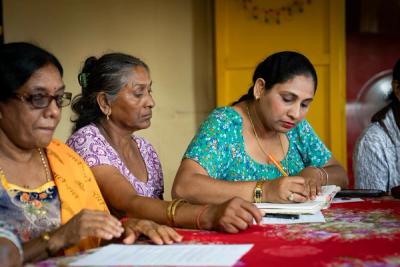
Fiji: Atishma, a member of a women's club in the community of Waituri fills out a form as Jasodra and Raj look on. The women's group is part of a project by the Pacific Centre for Peacebuilding (PCP) called the Women's Peacebuilding Ambassadors Network linking women across Fiji as ambassadors for peacebuilding in their communities. Photo: Alipate Laveti/Oxfam
Writing to your Member of Parliament
Whether you're advocating for climate action or social equality, contacting your local MP is a powerful, accessible way to push for meaningful progress.